Cubtale: Pregnancy & Baby
- 4.3
- Rating
- 50.00K
- Installs
- Free
- Price

 Analysis by App-foxy
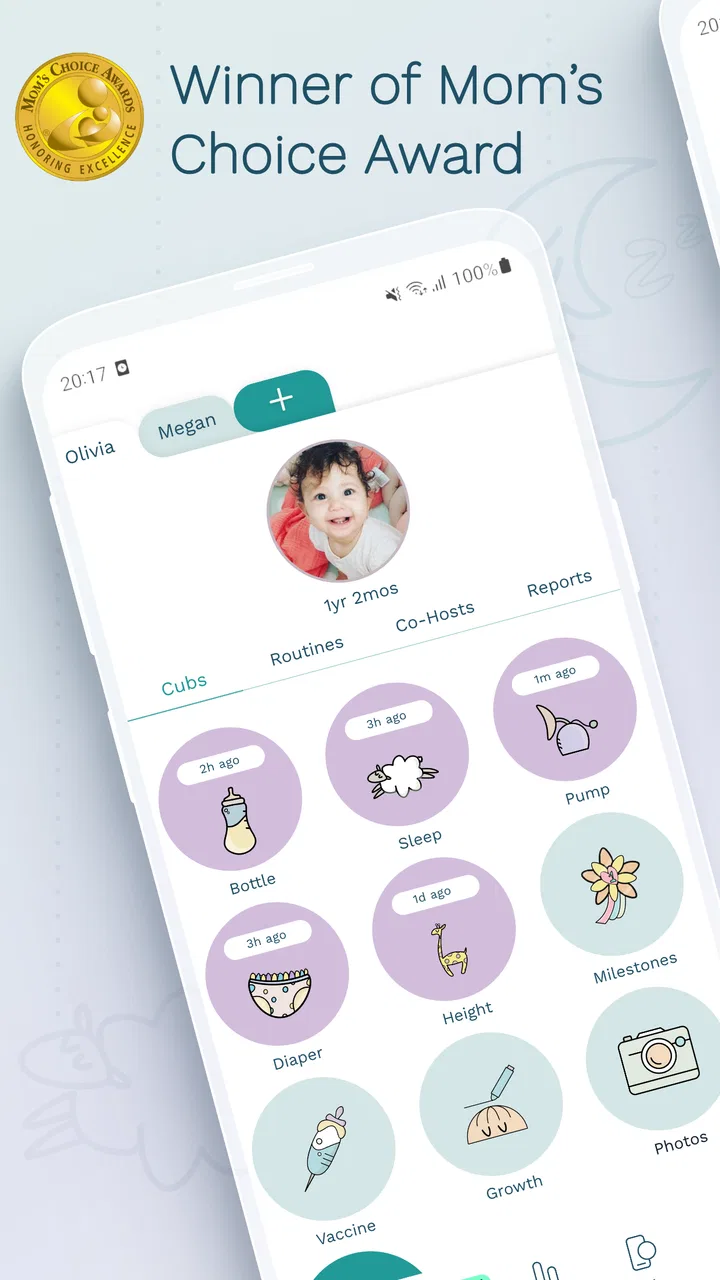
I found Cubtale: Pregnancy & Baby most useful when baby care started to feel less like a routine and more like a stream of small details I had to remember. A feeding here, a wet diaper there, a short nap that seemed to explain a fussy afternoon—none of these events is difficult to record alone, but together they quickly become hard to track. Cubtale brings those everyday notes into one parenting app from Cubtale, with a focus on breastfeeding, bottle feeds, sleep, diaper changes, and growth.
My overall impression is that it works best as a shared memory aid rather than a substitute for medical advice or a rigid parenting program. I would recommend it to parents who want a clearer picture of the day, especially during the first months when sleep deprivation makes mental tracking unreliable. I would not recommend treating every graph or pattern as a diagnosis. The value is in making observations easier to collect and discuss.
How the app feels in everyday use
The current version is 4.5.5, and the app has been available since February 9, 2021. That history matters because this is not a brand-new tracker trying to prove its usefulness in a single novelty feature. It has had time to settle into the practical job of recording recurring baby-care events. The free download also lowers the barrier to trying it during a busy week, although optional in-app purchases range from $2.99 to $139.99 per item.
You May Also Like

 Blood Strike: 2.5 Anniversary
Blood Strike’s Loadouts Turn Every Drop Into a Tactical Gamble
A close look at Blood Strike’s custom loadouts: how fast access to signature weapons reshapes its battle royale rhythm, rewards preparation, and narrows the gap between fights.

 Pandora - Music & Podcasts
Pandora’s Music Is Easy to Start, but Harder to Recover
Pandora’s strength is its low-effort path from a seed to a station. Its weak spot is how much confidence it asks you to place in connection, setup, and quiet recovery.

 8 Ball Pool
 Is Built on Rivalries, Rematches, and Routine
A close look at the rivalries, rematches, shared routines, and unanswered safety questions that turn a quick pool match into a persistent mobile community.

 Samsung Music
’s Quiet Strength Is Playing What You Already Own
Its reach comes less from spectacle than from dependable access to a personal library. That simplicity is both the app’s strongest retention engine and its ceiling.

 AccuWeather: Weather Radar
AccuWeather Review: A Quick, Clear Forecast for Everyday Decisions
For everyday plans, the best forecast is the one you can understand quickly. AccuWeather makes rain timing, radar, and local conditions easy to act on, with a few trade-offs.

 Hill Climb Racing
Why Hill Climb Racing Still Turns Crashes Into One More Run
A tiny car, a bumpy hill and one more upgrade: Hill Climb Racing keeps resurfacing because its simple chaos makes every near-miss feel personal.
More From Our News Desk



I like the basic idea of opening one place whenever something important happens. Instead of keeping a note on the refrigerator for feeds, a phone timer for naps, and a separate conversation thread for diaper changes, I can build a more coherent daily record. That is particularly helpful when two adults share care. A parent returning from work can understand what happened without asking for a complete verbal handover.
The app belongs squarely in the parenting category, but its usefulness depends on how lightly you use it. New parents can easily turn tracking into another source of pressure. I found the best approach was to record information that would actually help with the next decision: whether the baby recently fed, when sleep last happened, or whether a change in routine was becoming noticeable. Logging every tiny detail only makes sense if that detail serves a purpose.
Its store rating is a 4.5 average from around 1.5 thousand ratings, and the app has more than 50 thousand installs. Those figures suggest a real audience without making the product feel like a universal answer for every family. I would read the positive reception as evidence that the central tracking idea works for many parents, not as proof that every household will enjoy entering data repeatedly.
A realistic day with Cubtale
Imagine a parent who wakes after a broken night and cannot remember whether the last feed happened before or after the baby settled. In that moment, a quick record is more useful than trying to reconstruct the evening from memory. Later, when the baby is unsettled, the parent can look back at the sequence of feeding, sleep, and diaper changes instead of guessing from a vague feeling that “something is off.”
The same record can help during a handoff. One caregiver may have handled the morning while another takes over in the afternoon. Rather than repeating every event aloud, the second caregiver can review the day and ask a more focused question. That does not eliminate communication, but it makes communication less dependent on perfect memory.
I also see value during appointments. A parent can use the accumulated notes to describe routines more clearly, especially when tiredness makes exact recall difficult. The important distinction is that the app organizes observations; a pediatric professional still needs to interpret concerns. If a baby is feeding poorly, unusually sleepy, dehydrated, or otherwise unwell, I would contact a healthcare professional instead of waiting for an app pattern to provide reassurance.
What I would track, and what I would leave out
My first practical tip is to decide in advance which events deserve consistent logging. Feeding and sleep are often the most useful starting points because they can be compared with mood and energy across the day. Diaper changes may matter when a parent is watching general routines or preparing information for a clinician. Growth records can be helpful when used as part of a broader health conversation rather than as a daily source of anxiety.
My second tip is to keep the routine simple enough that both caregivers will actually follow it. A beautifully detailed record that only one exhausted adult maintains is less useful than a modest record that survives real life. I would begin with the categories that answer current questions, then add more only when there is a clear reason.
My third tip is to review the record at a calm time instead of staring at it after every entry. Looking at one isolated feed or nap can create unnecessary worry. A broader view may reveal a routine, but it can also reveal that the day was simply irregular. The app can support reflection; it should not become a test that parents feel they are constantly failing.
Where the experience is genuinely helpful
The strongest use case is continuity. Babies do not care which caregiver remembers an event, but caregivers need a dependable way to pass information between them. A shared tracker can be especially convenient when grandparents, partners, or another trusted caregiver occasionally take over. It reduces the number of details that must be held in someone’s head.
Another strength is the combination of several care areas. Feeding alone tells only part of the story. Sleep alone can be misleading. When feeding, sleep, diaper changes, and growth are considered together, parents have a better chance of noticing relationships in their own routine. I am careful not to call these relationships medical conclusions, but they can make everyday conversations more concrete.
The free price is also meaningful for families who want to test the workflow before committing. I would start without assuming that every optional purchase is necessary. Use the core routine first, see whether recording becomes natural, and only then decide whether an added purchase solves a problem you actually have. The wide range of purchase prices makes it especially important to understand what you are buying before confirming anything.
How it compares with ordinary alternatives
The most obvious alternative is a paper notebook. Paper wins when speed, privacy, and zero setup matter. It can sit beside a changing station, work without a charged phone, and accept messy notes immediately. For a single caregiver with a straightforward routine, a notebook may be enough. Its weakness is searching, summarizing, and sharing. Finding yesterday’s feeding notes in a tired moment is harder on paper than in a dedicated app.
A general notes app is more flexible, but that flexibility creates its own work. Parents have to invent labels, timestamps, and a consistent format. Cubtale is more purpose-built for baby routines, so it makes more sense when the same types of events happen repeatedly. The trade-off is that a specialized tracker can feel restrictive if your family wants to record unusual details or combine baby care with unrelated household planning.
Built-in phone reminders are useful for a single upcoming task, such as remembering to call a clinic. They are not designed to show the relationship between several recurring care events. Cubtale is better suited to building a history, while reminders remain better for one-off actions. I would use each for its proper job rather than expecting one tool to replace the other.
Finally, some parents may prefer a broader pregnancy or family organizer. Cubtale’s appeal is its concentration on baby-care tracking. If you want a large planning system that covers every household responsibility, another type of app may fit better. If your immediate need is a record of feeds, sleep, diapers, and growth, a focused tool is less distracting.
Friction points parents should expect
The unavoidable weakness is manual effort. Every useful record depends on someone remembering to enter it. During a difficult night, a parent may skip entries, enter them late, or forget which caregiver handled what. That does not make the app defective, but it means the resulting history will never be perfectly complete. I would treat gaps as normal rather than trying to reconstruct every missing minute.
Tracking can also become emotionally heavy. Parents who are already worried may check the record too often and interpret ordinary variation as a warning. The app is most helpful when it supports a question, such as “What usually happens before this nap?” It is less helpful when it encourages constant comparison with an imagined perfect schedule.
There is also a learning curve in deciding how much information to record. The categories sound straightforward, but real life is not always neat: feeds overlap, naps are interrupted, and caregivers may describe the same event differently. A family should agree on a simple shared habit so the record remains understandable. Consistency matters more than obsessive precision.
Parents should also remember that a free download does not mean every possible capability is free. Optional purchases are part of the product experience, so I would check the purchase screen carefully and avoid assuming that an advanced option is required for basic tracking. This is not a reason to reject the app, but it is a reason to make the decision deliberately.
Who should use it, and who should skip it
I think Cubtale is a good match for first-time parents who want structure without maintaining several separate systems. It also suits households where care is shared and handoffs are frequent. Parents preparing for a pediatric appointment may appreciate having organized observations instead of relying entirely on memory. The app can be particularly useful when a routine is changing and the family wants to see what is actually happening.
I would be more cautious if you dislike logging, already have a reliable notebook, or find tracking increases your anxiety. In those cases, the app may create another obligation without improving your day. It is also not the right choice for someone looking for diagnosis, individualized medical guidance, or a guaranteed sleep or feeding schedule. Its role is documentation and organization.
Families with a baby who needs urgent medical attention should not delay care to collect more entries or wait for a trend. An app record can help you communicate with a professional, but it cannot replace that professional’s assessment. This boundary is important because the convenience of having information in one place can otherwise create false confidence.
What the recent state tells existing users
For existing users, the current version number signals an established product rather than an untouched first release. I would expect the sensible benefit of staying updated to be continued access to the maintained experience, but I would not assume that a version label alone changes the way every family uses the app. The core decision remains practical: does opening it and recording events fit your household?
Someone moving from paper may notice the biggest difference immediately in organization and handoff. Someone already using another tracker should compare the actual daily workflow rather than switching because the interface looks newer. Exporting or rebuilding a history can be tiring, so I would change tools at a natural transition point, such as when the existing method has clearly stopped answering your questions.
New users should give themselves a short trial period with modest expectations. Record only the categories that matter, involve every regular caregiver, and review whether the information changes anything you do. If it merely produces more entries without helping decisions or conversations, simplifying the routine—or leaving the app—may be the better result.
What I would watch before committing
I would pay attention to how quickly the app fits into a real night, not just how clear it appears during a calm setup. A tracker earns its place when recording is quick enough after a feed or diaper change and when another caregiver can understand the history without a long explanation. I would also watch whether the purchase options remain easy to understand as needs change.
I would keep an eye on whether the app continues to feel like a supportive record rather than a source of pressure. Product evolution is valuable when it reduces friction, clarifies information, or makes shared care easier. New options are not automatically improvements if they make a simple routine feel more complicated. For me, the best direction is one that preserves quick logging and readable history.
My final recommendation is measured but positive. Cubtale is a practical parenting app for families who want one place to record the small events that shape a baby’s day. Its strongest contribution is not a promise of perfect routines; it is the relief of having a dependable record when sleep deprivation makes memory unreliable. Start with the free experience, keep the tracking habit realistic, and use the notes to support conversations rather than judge yourself. If that approach matches your needs, this is a useful companion. If you want medical answers, an all-purpose family organizer, or no manual input at all, a different option will serve you better.
It is rated for Everyone and requires Android 8.0 or later, which makes it accessible to many Android users. I would still judge it by the daily habit it creates, not by its availability alone. The best reason to install it is simple: it can turn scattered baby-care memories into information you can actually use.
FAQs for Cubtale: Pregnancy & Baby
01What features does Cubtale: Pregnancy & Baby offer?
Cubtale: Pregnancy & Baby provides a comprehensive suite of tools to assist expecting and new parents. It includes pregnancy tracking, weekly baby development insights, kick counters, contraction timers, and a baby milestone tracker. Additionally, it offers personalized tips and advice to support parents throughout their journey.
02Is Cubtale: Pregnancy & Baby free to use?
Cubtale: Pregnancy & Baby offers a free version with essential features. However, there are premium subscription options available that unlock additional tools, personalized content, and ad-free experiences. Users can choose the plan that best suits their needs, making it flexible for different budgets.
03How secure is my data with Cubtale: Pregnancy & Baby?
Cubtale prioritizes user privacy and data security. The app employs encryption and follows strict privacy policies to protect user information. It does not share personal data with third parties without consent. Users can feel confident that their personal and baby-related information is securely managed.
04Can I customize the notifications in Cubtale: Pregnancy & Baby?
Yes, the app allows users to customize notifications to suit their preferences. You can set reminders for important tasks like prenatal appointments, medication, and baby activities. This feature ensures that you receive timely alerts without being overwhelmed, helping to manage your schedule effectively.
05Is Cubtale: Pregnancy & Baby available on both Android and iOS?
Cubtale: Pregnancy & Baby is available for download on both Android and iOS platforms. Users can easily find the app on Google Play Store and Apple App Store. It is designed to work seamlessly across different devices, ensuring a smooth user experience for all parents.
Pros
- User-friendly interface for easy navigation.
- Comprehensive tracking for pregnancy milestones.
- Customizable reminders for appointments and tasks.
- Informative articles tailored to each pregnancy stage.
- Syncs seamlessly with partner's app for updates.
Cons
- Limited features in free version.
- Requires constant internet for updates.
- Some features locked behind premium.
- Occasional bugs in notification system.
- Not all articles are available offline.

Cubtale: Pregnancy & Baby
Gallery